What is Ai & UE
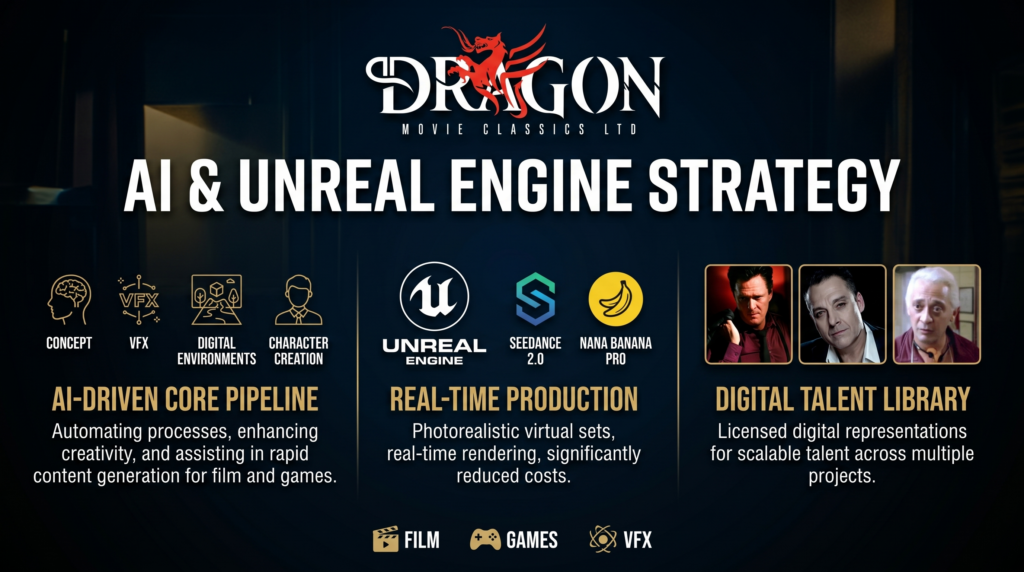
DRagon Movie Classics explain it's Ai & UE Strategy
DRagon Movie Classics will integrate Artificial Intelligence (AI) at the core of its film, gaming, and visual effects production pipeline. AI refers to advanced computer systems capable of learning patterns, generating content, automating complex processes, and assisting creative teams in producing high-quality digital media faster and more efficiently.
Within DRagon Movie Classics, AI will support multiple stages of production, including concept development, visual effects, digital environments, character creation, and post-production workflows. By combining AI tools with powerful real-time technologies such as Unreal Engine, Seedance 2.0, and Nana Banana Pro, the company can produce cinematic quality films, games, and immersive experiences at a significantly reduced cost compared to traditional production methods. Unreal Engine enables filmmakers to create photorealistic virtual sets, environments, and visual effects in real time, reducing the need for expensive physical sets, multiple locations, and lengthy post-production processes.
AI will also enhance creative scalability. It can assist with rapid prototyping of scenes, digital doubles, special effects, animation, and large-scale world-building for both film and game development. This allows DRagon Movie Classics to produce more content, explore creative concepts quickly, and respond efficiently to evolving market opportunities.
A key long-term initiative is the development of a proprietary digital talent library. DRagon Movie Classics intends to acquire licensed image rights for well-known actors and performers, enabling the company to create high-quality digital representations that can appear across multiple films, games, and virtual productions. This approach creates a reusable talent ecosystem where digital actors can be deployed across multiple projects while maintaining full legal licensing and performer agreements.
Currently, DRagon Movie Classics has acquired the image rights to several well-known actors including Michael Madsen (Reservoir Dogs, Kill Bill, Thelma & Louise), Tom Sizemore (Saving Private Ryan, Heat, Black Hawk Down), and Don Calfa (Return of the Living Dead, Weekend at Bernie’s, Foul Play). These licensed digital assets form the foundation of a growing talent library that can be integrated into future productions across film, games, and digital media.
By combining AI technologies, Unreal Engine real-time production, and a licensed digital talent library, DRagon Movie Classics aims to create a scalable and cost-efficient production model. This strategy allows the company to produce high-quality entertainment while maintaining creative control, reducing production costs, and building long-term intellectual property value.
The result is a modern entertainment studio designed for the next generation of storytelling where advanced technology supports creativity, accelerates production, and unlocks new opportunities across multiple media platforms.
UNREAL ENGINE & Ai tutorials
Why a Digital Actor Library Could Become a Major Entertainment Asset
A digital actor library represents a powerful long-term asset for a modern entertainment studio. By securing licensed image rights to well-known performers and building high-quality digital recreations of them, a studio can create a reusable talent ecosystem that can be deployed across multiple films, games, television productions, and interactive media.
Traditionally, casting actors requires coordinating schedules, negotiating contracts for each production, and managing travel, location shoots, and long filming schedules. A digital actor library removes many of these limitations. Once a performer’s likeness is licensed and a high-quality digital model is created, that digital actor can be used across multiple projects simultaneously. This dramatically increases production flexibility and reduces scheduling constraints while maintaining the recognisable presence of established talent.
From a financial perspective, a digital actor library becomes a scalable intellectual property asset. Instead of paying full performance fees for every production, a studio can license and reuse digital likenesses across films, games, animation, advertising, and virtual experiences. This allows the same actor to generate value across multiple revenue streams, including film production, video games, streaming content, merchandising, and interactive media.
The technology behind digital actors is advancing rapidly. Real-time production tools such as Unreal Engine allow studios to place digital performers into photorealistic environments and scenes without the traditional costs of large film sets, location shooting, or extended visual effects pipelines. Artificial Intelligence tools further enhance this process by helping generate realistic facial animation, dialogue synchronization, and digital doubles that maintain the performance style of the original actor.
For investors, the long-term value lies in ownership and control. A well-managed digital actor library becomes similar to a character franchise or intellectual property portfolio. As the library grows, the studio builds a unique catalog of licensed performers that can appear across multiple projects for many years. These digital assets can be continually upgraded as technology improves, increasing their realism and market value over time.
In addition, digital actors open new creative opportunities. Studios can place performers into historical settings, science fiction worlds, or video game environments that might otherwise be impossible or cost-prohibitive using traditional production methods. This flexibility allows filmmakers and game developers to tell more ambitious stories while maintaining strong brand recognition through familiar faces.
For DRagon Movie Classics, the development of a licensed digital actor library represents both a creative advantage and a long-term financial asset. By combining artificial intelligence, real-time production technology, and legally licensed performer likenesses, the company can create a scalable production model capable of generating content across multiple media platforms while building a valuable and reusable entertainment asset.
Ai - Actors now represented by DRagon Movie Classics



Michael Madsen
Michael Madsen is an American actor known for his distinctive screen presence and powerful performances in both independent and major Hollywood films. With a career spanning more than four decades, he became widely recognized for his roles in Quentin Tarantino films including Reservoir Dogs and Kill Bill. Madsen has appeared in over 200 film and television productions, often portraying intense and complex characters. His work includes notable roles in Thelma & Louise, Donnie Brasco, and Sin City, establishing him as one of Hollywood’s most recognizable character actors.
Tom Sizemore
Tom Sizemore was an American actor celebrated for his commanding performances in dramatic and action films. Rising to prominence in the 1990s, he became known for portraying tough, authoritative characters in major Hollywood productions. His most acclaimed roles include Saving Private Ryan, Heat, and Black Hawk Down. Throughout his career, Sizemore worked alongside many of the industry’s leading directors and actors, building a reputation for intense and memorable performances across film and television.
Don Calfa
Don Calfa was a respected American character actor known for his memorable roles in film and television. He gained cult status for his performance as mortician Ernie Kaltenbrunner in the horror classic The Return of the Living Dead. Over his long career, Calfa appeared in a wide variety of productions including Weekend at Bernie’s, Foul Play, and numerous television series. His unique screen presence and versatility made him a familiar face in both comedy and genre films.